

 LOCATIONS
Your Spring Fertilizer Guide for Cool-Season Lawns in Southwest Ohio
Updated for the 2026 spring season.
In This Article
- How Spring Fertilization Works Here
- Know Your Grass Before You Start
- Round 1: Early Spring Fertilizer and Pre-Emergent
- Round 2: Mid-Spring Fertilizer and Weed Control
- Soil Testing: Stop Guessing, Start Knowing
- Pre-Emergent: Getting the Timing Right
- How Fertilization Fits With Cleanup and Planting
- Common Spring Fertilization Mistakes
- Frequently Asked Questions
- Where to Go Next
This spring fertilizer guide covers what Southwest Ohio lawns actually need — and keeps it simple. Most cool-season lawns here do well with two well-timed spring applications and a stronger focus on fall feeding. The key is getting the timing right for our weather, our clay soils, and your grass type.
If you’ve ever guessed, or worried you were too early or too late, this guide lays out a simple schedule you can follow each year. It covers Round 1, Round 2, and where each step fits into the broader spring plan.
For the full picture of what to do in spring, start with the Spring Landscaping Guide for Southwest Ohio. The fertilizer plan covered here fits into that larger guide as one of the three main phases of spring work.
Spring Fertilizer Timing at a Glance
- Round 1 (Early Spring): When the soil hits about 50–55°F and the lawn is starting to grow, usually early to mid-March in our area. Use a slow-release fertilizer with pre-emergent to feed the lawn and block crabgrass in one pass.
- Round 2 (Mid-Spring): About six weeks after Round 1, in April or early May. Apply a fertilizer combined with broadleaf weed control to handle dandelions and clover while keeping the lawn fed.
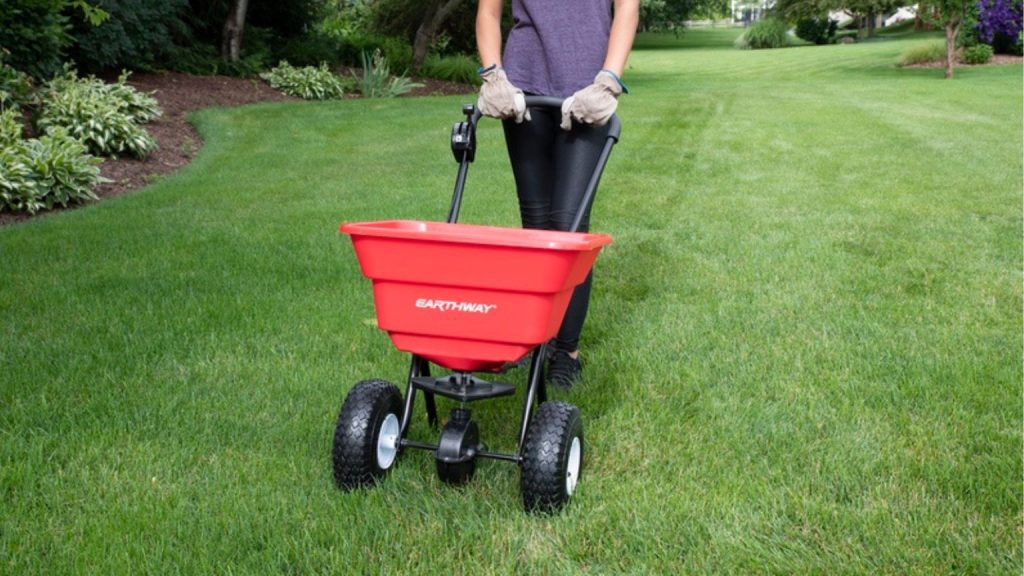
Timing fertilizer to soil temperature rather than the calendar makes a measurable difference in results.
Know Your Grass Before You Start
Most lawns in Southwest Ohio are cool-season grasses. Tall fescue, Kentucky bluegrass, and perennial ryegrass all follow the same basic pattern: strong growth in spring and fall, slower in summer heat. If your lawn is a typical mix, the schedule in this guide fits. If you’ve installed a specialty turf or sod, check the seed label before you start.
The national “4-step” programs you see advertised are built around a calendar, not your lawn. Southwest Ohio has its own timing, its own clay soils, and its own frost windows. Match the plan to your grass and your ground — not a TV commercial.
— Ryan Dunham, Champion Mulch & Landscape Supply
One other thing worth knowing before you buy: a soil test takes the guesswork out of the whole process. Heavy clay soils around Dayton and Cincinnati often have different needs than what’s printed on a national fertilizer bag. More on that below.
Round 1: Early Spring Fertilizer and Pre-Emergent
The first application does two jobs at once. It wakes the lawn up after winter and lays down a weed barrier to stop crabgrass before it starts. Get the timing right and you save a lot of work later in the season.
When to Apply Round 1
Soil temperature is more dependable than the calendar for this one.
-
- Target soil temps of 50–55°F for several days in a row before applying.
- In Southwest Ohio, that usually falls in early to mid-March, depending on how the winter has gone.
- A simple soil thermometer pushed 2–3 inches into the soil gives you a reliable reading. Local soil temperature maps are also available online if you want a quick reference.
Avoid putting fertilizer down when the ground is still frozen, saturated, or covered in snow. The product will sit on top or wash away before the lawn can use it.
What to Apply for Round 1
Champion carries Shaw’s professional turf fertilizers from Knox Fertilizer Company — an Indiana-based manufacturer with over 70 years supplying the professional turf industry. Shaw’s products use SurfCote polymer coating technology, which releases nitrogen more uniformly over time for steadier green-up and fewer application passes.
For Round 1, the product is Shaw’s 10-0-3 100% SurfCote Dimension (Step 1 of the Shaw’s 4-Step Program).
-
-
- Active ingredient: Dithiopyr (Dimension) 0.13% — one of the most trusted pre-emergent herbicides in professional turf care
- Fertilizer analysis: 10-0-3
- Slow release: 100% SurfCote — up to 4 months of controlled nitrogen release from a single application
- Coverage: approximately 14,000 sq ft per 42 lb bag
-
The 100% SurfCote nitrogen coating is the meaningful difference from products with partial slow release. Every granule is polymer-coated, so the lawn gets a consistent feed over the season rather than a quick flush followed by a hard stop. Apply at the labeled rate — more is not better here.
One important note: Dimension is a pre-emergent herbicide, which means it prevents crabgrass seeds from germinating. Do not overseed bare spots within 3–4 months of a Dimension application, as this will prevent new grass seed from establishing. Plan overseeding for fall, or address bare spots before Round 1 goes down.
How to Apply Round 1
-
-
- Use a broadcast or rotary spreader and set it to the labeled rate for the product you’re using. Each Shaw’s bag includes calibration guidance for common spreader models.
- Walk at a steady pace and overlap your wheel tracks slightly to avoid streaks or skipped areas.
- Keep the product off driveways and sidewalks. Sweep any that lands there back onto the lawn before it rains.
- Water lightly after application if rain isn’t expected within a day or two, to activate the pre-emergent barrier.
-
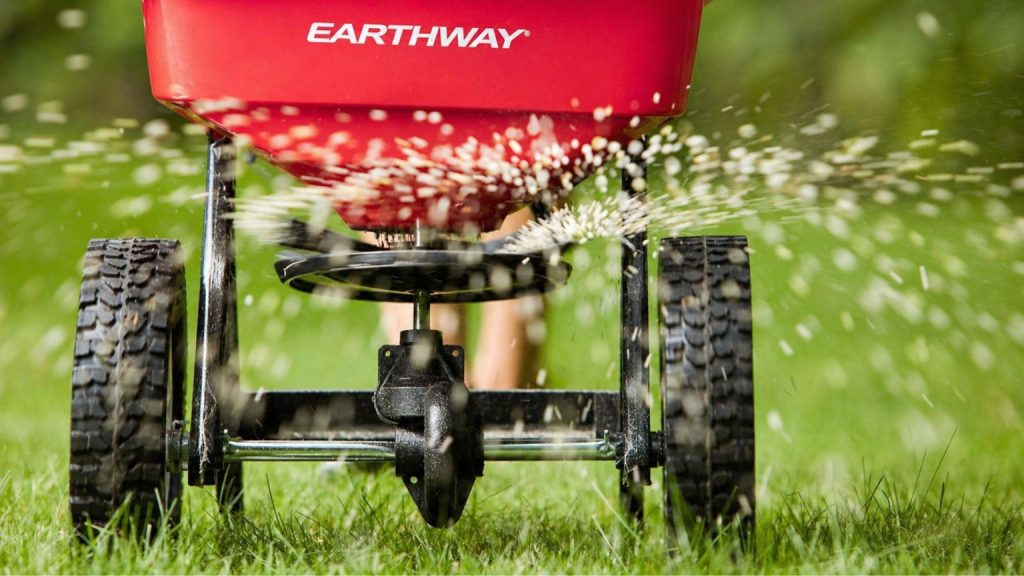
A steady pace and slight wheel-track overlap prevents the streaky pattern that shows up weeks later as alternating green and yellow stripes.
Round 2: Mid-Spring Fertilizer and Weed Control
Round 2 keeps the lawn moving through peak spring growth while addressing broadleaf weeds that are already visible in the turf. Dandelions, clover, chickweed — if they’re up and growing, this is the pass that handles them.
When to Apply Round 2
-
-
- Count roughly six weeks from your Round 1 date.
- In our area, that usually puts Round 2 between early April and mid-May.
- Apply when the lawn and weeds are actively growing — this is a post-emergent application, meaning it works on weeds that are already up, not seeds in the soil.
- Skip Round 2 if the lawn is under obvious stress from drought, disease, or heat.
-
What to Apply for Round 2
For Round 2, the product is Shaw’s 15-0-5 100% SurfCote SOP Weed and Feed (Step 2 of the Shaw’s 4-Step Program).
-
-
- Active ingredients: 2,4-D + MCPP + Dicamba — a proven broadleaf herbicide combination that handles dandelions, clover, chickweed, and other common broadleaf weeds
- Fertilizer analysis: 15-0-5
- Slow release: 100% SurfCote SOP — full polymer-coated nitrogen for consistent feeding
- Coverage: approximately 10,000 sq ft per 40 lb bag
-
The key distinction between Round 1 and Round 2 is the type of weed control. Round 1 (Dimension) is pre-emergent — it stops seeds before they sprout. Round 2 is post-emergent — it kills weeds that are already growing. They are not interchangeable by timing. Using a post-emergent product in early March before weeds have emerged won’t do much. Using a pre-emergent in late April after crabgrass is already up won’t stop what’s already growing. The two-round approach makes sure you’re covered in both windows.
Apply Round 2 when weeds are small and actively growing for the best result. Follow the bag rate for your spreader and water in lightly if rain isn’t expected.
Soil Testing: Stop Guessing, Start Knowing
A simple soil test keeps you from throwing money at the wrong problem.
-
-
- Test every few years, or before you change your fertilizer plan.
- OSU Extension and local labs can test for pH, phosphorus, potassium, and organic matter.
- Heavy clay soils around Dayton and Cincinnati often have different needs than what’s on a national fertilizer bag label.
-
Once you have results, you’ll know whether you actually need phosphorus, whether potassium is low, and whether soil pH is working against you. Without that baseline, you’re guessing. And guessing leads to buying nutrients you don’t need or missing the one thing that’s holding the lawn back.
Pre-Emergent: Getting the Timing Right
Crabgrass prevention comes down to timing. Pre-emergent doesn’t kill visible plants. It stops seeds from sprouting, which means the barrier has to be in place before germination starts.
For Southwest Ohio:
-
-
- Apply when the soil reaches 50–55°F for several days, before crabgrass seeds germinate.
- In most years, that window falls in early to mid-March.
- The forsythia bloom is still a useful visual cue: when forsythia is in full bloom, it’s time.
- If you’re using Shaw’s Step 1, your pre-emergent and Round 1 fertilizer are the same pass. One trip across the lawn handles both.
-
If you miss the window and crabgrass is already coming up, look for a post-emergent crabgrass herbicide labeled for your grass type and treat while the plants are small. Then plan to apply pre-emergent earlier the following spring. One season with some crabgrass isn’t a disaster — the goal is steady improvement, not perfection in year one.
The pre-emergent window is the one you really can’t make up for later. Everything else has a workaround. Miss the crabgrass window in March and you’re managing it all summer instead.
— Ryan Dunham, Champion Mulch & Landscape Supply
How Fertilization Fits With Cleanup and Planting
Fertilizer isn’t the first thing you do in spring. It fits into a sequence.
-
-
- Before Round 1: Do basic cleanup so fertilizer and pre-emergent can hit the soil, not piles of debris.
- Around Round 1: Early in the season, you’re also pruning, inspecting hardscape, and prepping beds.
- After Round 2: You’re into mowing, planting, and watering routines for the rest of the season.
-
The Spring Yard Cleanup Guide covers the cleanup side of the season. The Spring Planting Guide handles timing for flowers and vegetables. Each piece feeds into the next.
Common Spring Fertilization Mistakes
You don’t have to make these to learn from them.
Fertilizing too early. Putting product down on frozen or very cold soil means the lawn can’t take it up yet. You risk runoff or wasted product before any root activity begins.
Stacking too much nitrogen in spring. Heavy spring feeding pushes lush, shallow growth that struggles once heat and drought arrive in summer. Steady release beats a quick flush every time.
Ignoring soil tests. Guessing leads to buying the wrong blend or adding nutrients you don’t need. A soil test from OSU Extension costs less than a bag of fertilizer and points you toward what actually matters.
Treating Ohio like a warm-season state. Cool-season grasses don’t want the same schedule as zoysia or Bermuda. A plan designed for Kentucky bluegrass in Ohio looks nothing like one for lawns in Georgia.
Chasing burned spots with more fertilizer. If a spot is already stressed or scorched, more product won’t fix it. Address water, disease, or compaction first. Fertilizer feeds healthy grass; it doesn’t repair damaged turf.
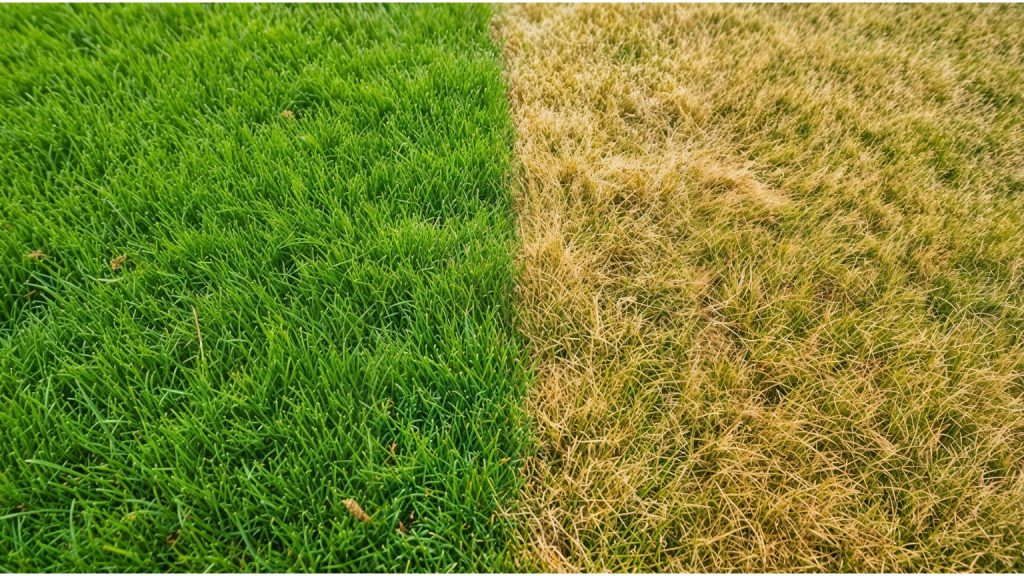
Stressed or yellowed turf needs water and root care before more fertilizer. Timing and soil health matter more than application volume.
Spring Fertilizer Guide: Frequently Asked Questions
When should I apply spring fertilizer in Southwest Ohio?
Plan on two applications. Round 1 goes down when the soil is around 50–55°F and the lawn is starting to grow, often early to mid-March. Round 2 follows about six weeks later, somewhere between early April and mid-May.
Can I apply pre-emergent and fertilizer at the same time?
Yes. Shaw’s Step 1 combines both in one bag. Apply at the labeled rate, water in lightly, and one pass handles your early spring feeding and crabgrass prevention together.
Is spring or fall fertilizing more important here?
Fall is generally more important for cool-season lawns. Fall feeding builds root reserves for winter and sets the foundation for a strong spring. Spring feeding supports that growth and adds weed control. Both matter; fall just does more of the heavy lifting.
What happens if I fertilize too early?
If the soil is too cold, roots can’t take up nutrients. The product may leach away with rain or sit unused — wasting money and contributing to runoff. Wait for that 50–55°F soil temperature window.
How often should I fertilize in a year?
Most Southwest Ohio lawns do well with two spring applications and one or two fall applications, guided by a soil test and a steady plan. Chasing a strict four-pass schedule isn’t necessary if your timing and products are right.
What is SurfCote and why does it matter?
SurfCote is Knox Fertilizer’s polymer coating technology. Each granule is encapsulated so nitrogen releases gradually as soil moisture and temperature change — rather than all at once. The result is steadier green-up, less risk of burn or flush growth, and longer feeding from a single application. Shaw’s Step 1 uses 100% SurfCote, which means every granule in the bag is coated.
Do I need the full 4-Step program, or can I keep it simple?
The Shaw’s 4-Step Program is a structured, season-long approach that takes the guesswork out of timing. Steps 1 and 2 cover spring. Steps 3 and 4 carry you through summer and into fall. You can also keep things simple with a well-timed two-step spring plan and a focused fall application — especially if your lawn is in good shape and your soil test doesn’t reveal significant deficiencies.
What if I missed Step 1 this spring? Is it too late?
Not at all. If crabgrass and broadleaf weeds are already showing up because the early-spring pre-emergent never went down, Shaw’s Total Weed Control is your catch-up option. One application clears the weeds already in the lawn and lays down a barrier that stops new crabgrass from taking hold, all while feeding the grass for months. It does the work of two products in a single pass, so a late start doesn’t have to mean writing off the whole season. Stop by any Champion location, and the team will confirm it’s a fit for your grass type before you head home with a bag.
Where to Go Next
If you’re standing in the yard working out what order to do things, start with cleanup, follow this fertilization plan, then move into planting and summer care. The Spring Landscaping Guide for Southwest Ohio ties everything together. The Spring Yard Cleanup Guide and the Spring Planting Guide give you step-by-step help for the other pieces of the season.
When you’re ready to stock up, Champion keeps Shaw’s professional fertilizers in stock at our stores in Dayton, Englewood, the Moraine/Kettering area, and West Chester. The full Shaw’s 4-Step Program is available, along with bulk mulch, topsoil, and compost for the rest of your spring work. Delivery is available within about 20 miles of each location.

