

 LOCATIONS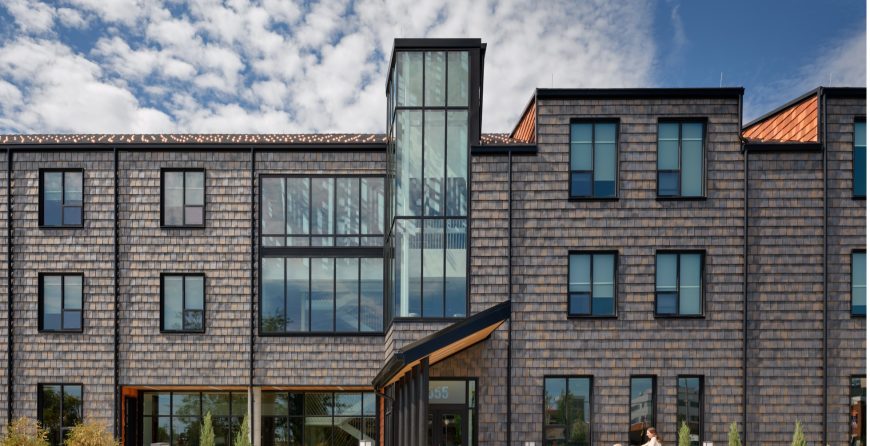
A Closer Look at the Programs, the People, and Why Keeping Families Close Changes Everything
RMHC Dayton has been serving families for 46 years. In our previous post, we shared why Champion Mulch & Landscape Supply is partnering with RMHC Dayton for 2026. That story started with Matt’s niece Maddy, her treatment at St. Jude, and the two months her mom Julie spent living at a Ronald McDonald House in Memphis. It ended with a simple idea: go local.
Now we want to talk about the organization itself. Not the partnership mechanics or the yard sign discount. Those details are coming in our next post. Right now, we want to answer a more basic question: what does RMHC Dayton actually do, and why does it matter so much?
Most people have a general sense. It’s housing for families with ill or injured kids. That’s accurate, but it barely scratches the surface.
Picture a family driving into Dayton from two hours away. Their child was just referred to a specialist at Dayton Children’s Hospital. They don’t know how long treatment will take. Could be days. Could be weeks. Could be a lot longer. They’ve packed a bag, called out of work, and arranged for someone to watch their other kids. They’re exhausted and scared, and they haven’t even started yet.
Now picture them pulling up to 555 Valley Street. That’s where the Ronald McDonald House sits. Directly across the street from the hospital. And what happens next can change the entire shape of their experience.
In This Article
More Than a Place to Sleep
The phrase “home away from home” gets used a lot. It can sound like marketing. In the case of the Ronald McDonald House, it’s closer to a literal description.
Families who stay at the house on Valley Street aren’t checking into a hotel. They’re moving into a temporary home during one of the hardest stretches of their lives. The House is set up to feel that way.
Each family gets a private guest suite. After the 2025 expansion, the House has 42 of them, designed to accommodate families of different sizes. Not tiny hospital rooms. Not cramped hotel doubles. Actual living space with room for parents and siblings. The architect, Chas Wiederhold from GBBN, described the approach as designing “through the eyes of a child,” making sure the spaces worked for the smallest people who’d be living in them.
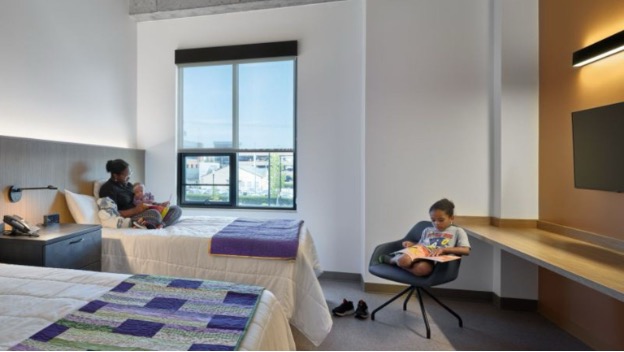
A guest suite at RMHC Dayton.
There are communal kitchens where families store their own food and cook their favorite comfort meals. Volunteers and local businesses regularly sponsor hot meals for everyone. Home-cooked meals show up multiple times a week. There’s on-site laundry, so nobody has to figure out where the nearest laundromat is while their child is in treatment. Personal care items are provided. Play spaces give children, especially healthy siblings who’ve been uprooted from their routines, a place to just be kids for an hour.
The 2025 expansion added outdoor recreation areas for a breath of fresh air. For families spending their days inside hospital rooms and their nights worrying, having access to green space and fresh air isn’t a luxury. It’s a pressure valve.
And then there’s the part that’s hardest to put on a brochure. The community.
When Julie was living at the Ronald McDonald House in Memphis during Maddy’s treatment, she described it as a place where you didn’t have to explain yourself. Every family under that roof was dealing with something similar. The late-night conversations in the kitchen. The nod in the hallway from another parent who gets it. The absence of the question “so what’s going on with your kid?” because everyone already knows the answer is some version of “something terrible, and we’re getting through it.”
That kind of understanding doesn’t come from a building. It comes from the people inside it. But the building makes it possible.
Now consider the alternative. Without a Ronald McDonald House, that family from two hours away is looking at hotel bills they can’t afford, fast food from the hospital cafeteria, sleeping in waiting room chairs, driving back and forth until the gas money runs out. Some families face the impossible choice between being at their child’s bedside and going home to take care of their other children, keeping their job, or just sleeping in a real bed.
RMHC Dayton exists so that choice doesn’t have to be made.
Three Programs, One Mission
Most people think of Ronald McDonald House as a single building. In Dayton, it’s actually three separate programs serving families in different situations. All three are free. All three operate under the same principle: families are strongest when they’re together, and a child’s recovery depends on more than what happens in the treatment room.
The Ronald McDonald House — 555 Valley Street
The House itself is the flagship program. Open 365 days a year, it provides overnight lodging for families whose children are hospitalized or receiving outpatient treatment at one of seven medical service partners in the region.
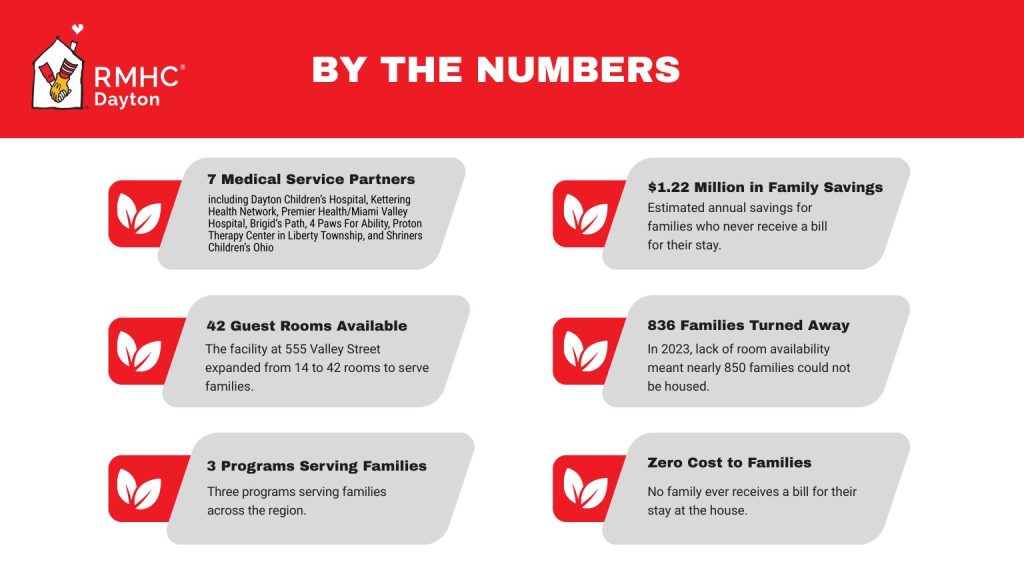
After the 2025 expansion, the house has 42 private guest rooms across three finished floors. Families pay nothing for their stay. No room charges. No fees for meals, laundry, or any of the support services. The House provides everything a family needs so they can focus entirely on their child.
Some families stay for a few nights while their child has a procedure. Others stay for weeks during a course of treatment. And some stay much longer. One family stayed for 373 consecutive nights. Another surpassed 394 nights while their child received complex care for craniofacial injuries. Those numbers represent months upon months of a family’s life spent inside the House, and every night was provided at no cost.
Families come from across Ohio and well beyond. Rural communities with no pediatric specialists nearby. Neighboring states. In some cases, families have traveled from other countries, including Bangladesh, Mexico, and Nigeria, to access the pediatric care available in Dayton.
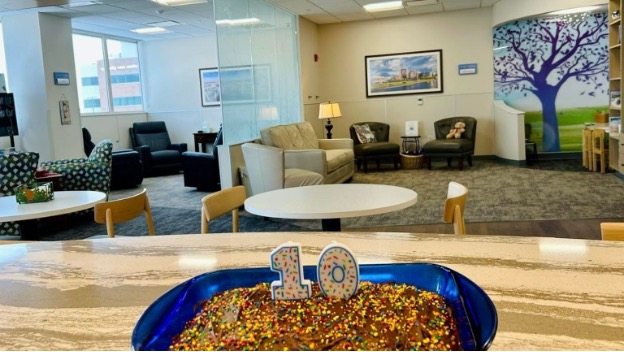
Celebrating 10 years in Dayton Children’s Hospital.
Opened in 2016, the Family Room operates differently from the House. It’s located inside Dayton Children’s Hospital, steps from the pediatric ward.The Family Room exists for a specific situation: when a parent can’t leave the building. Maybe their child is in critical condition and the medical team could need them at any moment. Maybe they just finished a 14-hour day at their child’s bedside and they need somewhere to sit that isn’t a plastic chair in a fluorescent hallway.
The Family Room gives parents a place to shower, eat a meal, rest on an actual couch, and decompress without leaving the hospital. It’s not overnight lodging. It’s a space designed to keep parents functional and present during the hours when they need to be closest to their child.
For a parent whose kid is in the ICU, walking across the street to the Ronald McDonald House might feel like too far. The Family Room puts support within a few dozen steps of the bedside.
Emmett’s Place at Miami Valley Hospital
The third program opened in 2017 at Miami Valley Hospital, and it carries a name with a story behind it.
Emmett Mikael Sorensen was born prematurely. He passed away shortly after birth. His parents, Dr. Derek and Emily Sorensen, wanted Emmett’s brief life to leave a lasting mark. They partnered with RMHC Dayton and the Miami Valley Hospital Foundation to create a Family Room specifically for NICU families and high-risk pregnant women.
Emmett’s Place serves a population with its own particular set of challenges. Premature births are sudden. There’s no time to plan, no time to pack. A mother who was expecting a routine appointment may find herself admitted for an emergency delivery and then watch her newborn fight for survival in an incubator. The father may be shuttling between the hospital and home, trying to manage work and other children while processing what just happened.
Emmett’s Place gives those families a space to breathe inside the hospital. A small sanctuary in the middle of a crisis they didn’t see coming. Every family who uses it benefits from a gift that started with grief and was transformed into something that helps others every single day.
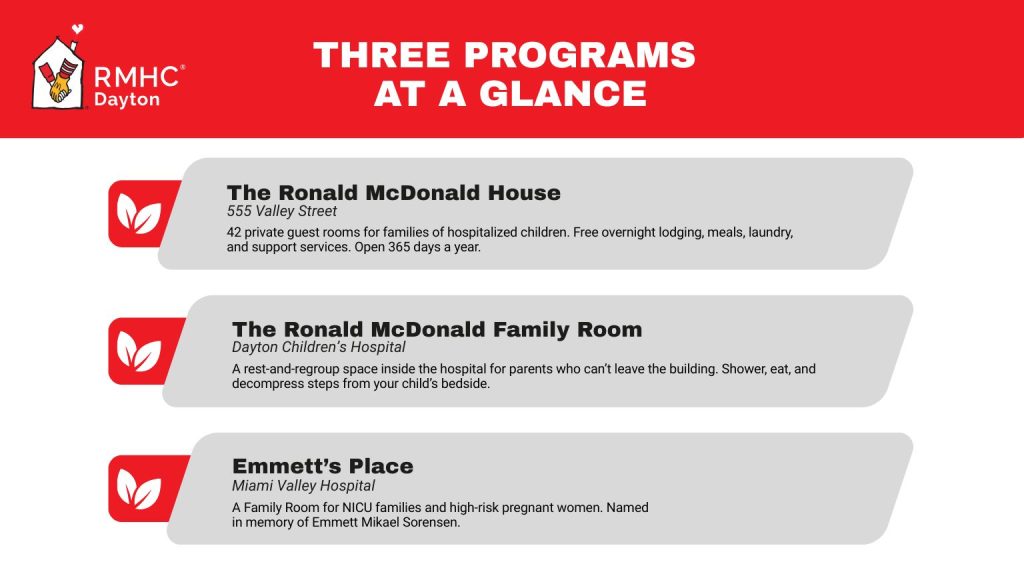
The Ronald McDonald Family Room (Dayton Children’s Hospital)
A rest-and-regroup space inside the hospital for parents who can’t leave the building. Shower, eat, and decompress steps from your child’s bedside.
Emmett’s Place (Miami Valley Hospital)
A Family Room for NICU families and high-risk pregnant women. Named in memory of Emmett Mikael Sorensen.
The Families
Statistics tell part of the story. In 2021, RMHC Dayton served more than 15,000 guests. That same year, the organization saved families an estimated $1.15 million in out-of-pocket costs for lodging, food, and transportation. Those are meaningful numbers.
But numbers don’t capture what it feels like to eat a meal with your spouse for the first time in four days because someone set up a Family Room down the hall from your child’s ICU bed.
The Sheehan family knows that feeling. Their son Logan faced a life-threatening battle with septic shock. During his treatment at Dayton Children’s, the Family Room became a lifeline. For the first time in days, Logan’s parents were able to sit down together, eat a meal, and take a breath. Not far from their son. Not at home while he was in the hospital. Just down the hall.
After Logan recovered, the Sheehans didn’t walk away. They became donors and volunteers. That pattern repeats itself often at RMHC Dayton. Families who were once guests come back to help the next family walking through the door. Volunteers cook the dinners. Former guests organize fundraisers. The cycle of gratitude, as RMHC describes it, is one of the things that keeps the organization running.
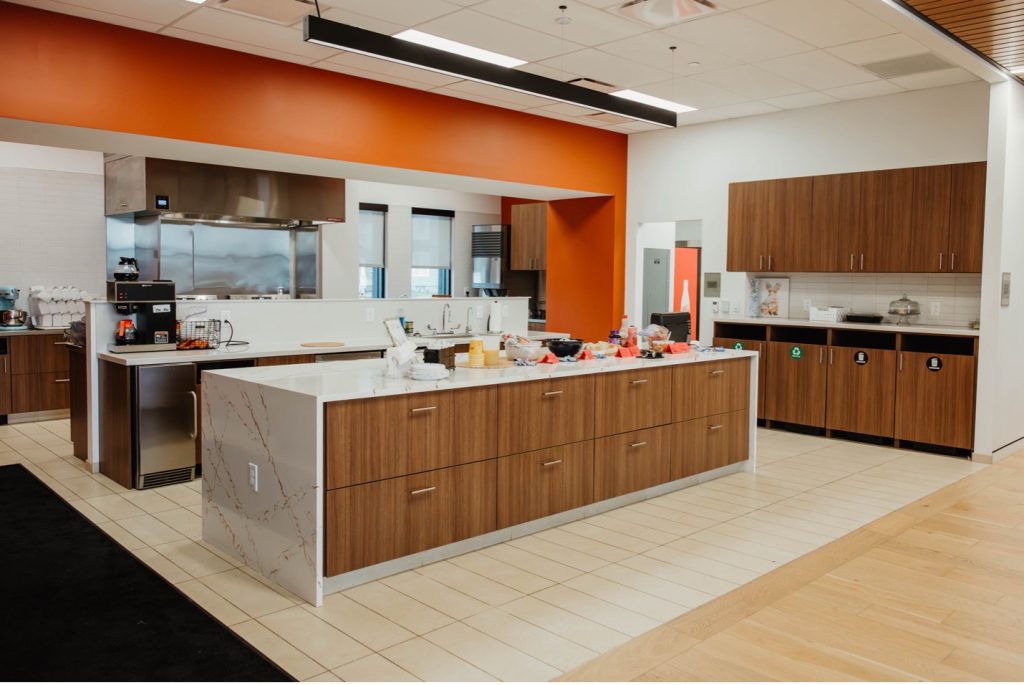
A volunteer-prepared meal at RMHC Dayton.
The long-term stays are perhaps the hardest to wrap your head around. A few nights is one thing. A few weeks is difficult. But some families have stayed at RMHC Dayton for over a year. Three hundred and seventy-three nights. Three hundred and ninety-four nights. Those stays represent children with cancer, craniofacial conditions, and other diagnoses that require months of treatment, surgery, recovery, and follow-up. For those families, the Ronald McDonald House isn’t temporary housing. It is, for all practical purposes, where they call home while their child fights to get better.
And the geographic range of families served says something important about Dayton’s role in pediatric medicine. The house has hosted families from rural Ohio communities with no nearby children’s hospitals. Families from Indiana, Kentucky, and other neighboring states. Families from Nigeria, Bangladesh, and Mexico, who traveled thousands of miles because a specialist in Dayton offered their child’s best chance.
For all of them, the cost of the room was the same: nothing.
Built Through the Eyes of a Child
For most of its history, RMHC Dayton operated out of a building that was too small for the demand. The original seven-bedroom house opened in 1980. A larger facility with 14 guest rooms replaced it in 1998. But the region’s growth as a pediatric medical hub outpaced the building.
By 2022, the House was turning away 63% of the families who came to them for housing. Think about that for a moment. For every family that got a room, nearly two families were told there was no space available. In 2024, while the new building was under construction, 906 families were turned away.
Those aren’t just numbers on a report. Each one represents a family with a sick child who needed a place to stay and was told the House was full.
That reality drove a major capital campaign. A $13 million contribution accelerated the construction timeline by six months. The result is the building that stands on Valley Street today: a 38,000-square-foot, purpose-built Ronald McDonald House with 42 guest rooms across three finished floors.
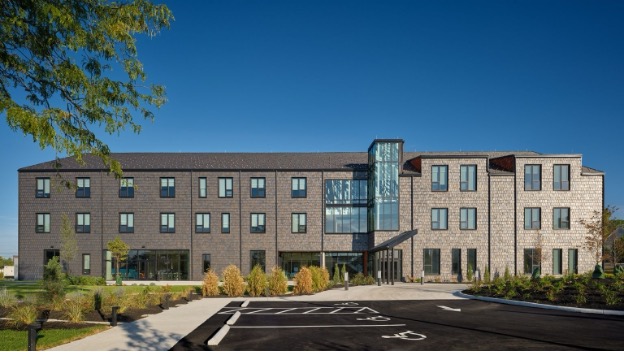
The new Ronald McDonald House Dayton, completed in 2025.
The design team at GBBN Architects approached the project with a philosophy they described as building “through the eyes of a child.” In practical terms, that meant thinking about how every space in the building would be experienced by kids at different ages and in different physical and emotional states.
Guest suites were “right-sized” to fit families, not just individuals. A mother with three kids needs a different room than a couple with one child. The new house accounts for that. Communal kitchens and dining spaces were designed to bring families together. Isolation is one of the biggest stressors for parents of hospitalized children, and shared meals create small moments of connection that matter more than most people would expect.
The outdoor play areas give families access to nature and fresh air. For children who spend their days in clinical environments, and for parents whose worlds have shrunk to the size of a hospital room, outdoor space isn’t a nice-to-have. It changes the texture of a day.
The expanded house now serves families connected to seven medical service partners in the region, including Dayton Children’s Hospital, Kettering Health Network, Premier Health/Miami Valley Hospital, Brigid’s Path, 4 Paws For Ability, Proton Therapy Center in Liberty Township, and Shriners Children’s Ohio. As Dayton continues to grow as a regional center for pediatric medicine, the need for family lodging grows with it. The merger of the Dayton and Cincinnati chapters into Ronald McDonald House Southwest Ohio, announced in early 2026, positions the organization to serve families across an even broader network in the region.
The new building was designed to change the turnaway number. Whether it’s enough will depend on how fast the region’s pediatric capacity continues to grow. But 42 rooms is a very different story from seven. Or 14.
Why Keeping Families Close Actually Works
There’s a tendency to think of the Ronald McDonald House as a nice thing that a community does for families in need. It is that. But it’s also something more specific, and there’s a growing body of research that supports it.
The academic term is Family-Centered Care. The core idea is straightforward: a child’s family is the most important constant in their life, and the family’s presence during treatment isn’t just comforting. It’s clinically meaningful.
A study published in Medical Care Research and Review surveyed more than 5,400 families and found that parents who stayed at a Ronald McDonald House reported higher involvement in their child’s daily care and a more positive overall hospital experience compared to families who stayed elsewhere. Those aren’t soft metrics. A parent who is rested, fed, and emotionally supported makes better decisions, asks better questions, catches things that overworked medical staff might miss, and provides the kind of steady presence that helps a child cope with treatment.
Sleep is a big part of it. Research has shown that parents who sleep at a Ronald McDonald House get meaningfully better rest than those who sleep in hospital chairs or at bedside. Anyone who has tried to sleep sitting up in a vinyl recliner under fluorescent lights while monitors beep every few minutes can tell you that’s not rest. It’s endurance. And it doesn’t take many nights of that before a parent’s ability to function starts breaking down.
The emotional side matters, too. A study of nearly 500 parents at Ronald McDonald House locations found that more than half experienced clinical anxiety during their child’s hospitalization, and about 20% experienced depression. The communal environment of the house, where families share meals, trade stories, and simply exist alongside others who understand what they’re going through, has been shown to help reduce that psychological burden.
None of this replaces medical treatment. A Ronald McDonald House doesn’t perform surgery or administer chemotherapy. But it creates the conditions that allow the people surrounding a sick child to show up as their best selves during the worst time of their lives. The doctors and nurses handle the medicine. The House handles everything else.
How You Can Support RMHC Dayton
In our next blog post, we’ll lay out the full details of Champion Mulch’s 2026 partnership with RMHC Dayton, including how the $0.50 per yard donation works, the yard sign discount program, the new social media initiative with rotating monthly sponsors, the add-on donation option at checkout, and our fall golf outing.
But you don’t have to wait for that post to get involved. Here are some ways to support RMHC Dayton right now:
Visit the RMHC Dayton website at rmhcdayton.org to learn more about their programs and upcoming events.
Make a direct donation through the RMHC Dayton donation page. Be sure to mention “Champion Mulch” in the comment section if you’d like your donation connected to our partnership.
Check the RMHC Dayton Wish List for items the house needs. Practical things like cleaning supplies, pantry staples, and personal care items make a real difference for the families staying there.
Volunteer your time. RMHC Dayton relies on volunteers for everything from preparing meals to organizing activities for families. Contact them through their website to learn about current opportunities.
If you’re a business owner, ask about sponsorship opportunities. Meal sponsorships, event support, and corporate giving all contribute to keeping the House running.
“RMHC Dayton supports families on their healthcare journey and empowers them to show up for their child, well-rested, well-nourished and able to thrive.”
— RMHC Dayton
The House on Valley Street has been taking care of families since 1980. The building is bigger now. The rooms are newer. The programs reach into two hospitals beyond the front door. But the mission hasn’t changed in 46 years. Keep families close. Remove the barriers. Let parents focus on their child.
When you buy mulch from Champion this year, you’re part of that. More on exactly how in our next post.
From January 1, 2026 through December 31, 2026, Champion Mulch, LLC will donate $0.50 of the purchase price for every retail yard of mulch purchased online at www.gotochampion.com or at participating locations to Ronald McDonald House Dayton to support its mission.

The 2026 Champion Mulch and RMHC Dayton yard sign.
Next in the series: Mulch for a Cause — the full details of Champion Mulch’s 2026 partnership with RMHC Dayton, including every way you can participate.
Frequently Asked Questions
Q: What is Ronald McDonald House?
A: Ronald McDonald House provides free temporary housing for families whose children are receiving medical treatment at nearby hospitals. Families get a private room, access to meals and kitchens, laundry, and support services at no cost.
Q: Who can stay at the RMHC Dayton house?
A: Families of children being treated at one of RMHC Dayton’s seven medical service partners in the region. Families are referred through the hospitals’ social work teams.
Q: How long can families stay?
A: There’s no fixed limit. Some families stay for a few nights, others for weeks or months. The House has accommodated families for over a year when a child’s treatment required it.
Q: Is there a cost to stay at the Ronald McDonald House?
A: No. Families never receive a bill for their room, meals, laundry, or any support services at RMHC Dayton.
Q: What is the Ronald McDonald Family Room?
A: A rest-and-regroup space located inside Dayton Children’s Hospital. It gives parents a place to shower, eat, and take a break without leaving the hospital building. It’s not overnight lodging but a daytime respite space.
Q: What is Emmett’s Place?
A: A Family Room inside Miami Valley Hospital specifically serving NICU families and high-risk pregnant women. It was created in memory of Emmett Mikael Sorensen and is operated by RMHC Dayton.
Q: How is RMHC Dayton funded?
A: Through a combination of individual donations, corporate sponsorships, fundraising events, grants, and support from local McDonald’s owner/operators who have been involved since the organization’s founding in 1980. Volunteers also provide significant in-kind support.
Q: Can I volunteer at RMHC Dayton?
A: Yes. Volunteers help with meal preparation, family activities, facility upkeep, and more. Visit rmhcdayton.org for information on current volunteer opportunities.
Q: How is RMHC Dayton connected to McDonald’s?
A: McDonald’s owner/operators have been founding partners and ongoing supporters of RMHC Dayton since 1978. While RMHC operates as an independent nonprofit, McDonald’s provides significant corporate support and local franchisees serve on the board of trustees and contribute to fundraising efforts.
Q: How does Champion Mulch’s partnership support RMHC Dayton?
A: Champion Mulch donates $0.50 from every retail yard of mulch sold in 2026 to RMHC Dayton. Customers can also participate through the $3 yard sign discount, add-on donations at checkout, and a social media program. You can also donate directly at rmhcdayton.org/donate (please mention “Champion Mulch” in the comment box so they know we sent you). Full details about all partnership programs are coming in our next blog post.
Q: Where is the Ronald McDonald House in Dayton?
A: 555 Valley Street, Dayton, Ohio, directly across from Dayton Children’s Hospital.

